
Blog post
From AI Pilots to Trusted Knowledge Workflows
15 Jun 2026

by Hong Zhou, VP of Product & AI Innovation
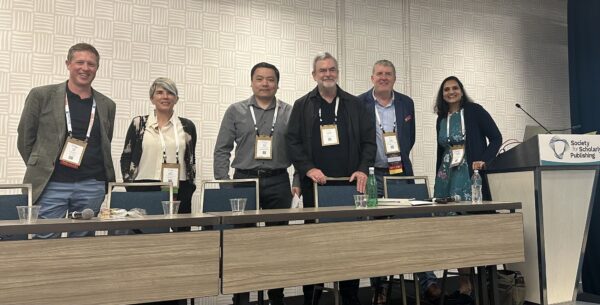
L–R: Paul Gee, Ann Michael, Hong Zhou, Thad McIlroy, Adrian Stanley, and Chhavi Chauhan at the SSP 2026 Annual Meeting
It was an honor to join the Society for Scholarly Publishing 48th Annual Meeting as a panelist for the session, "From Alexandria to Super AGI: Reimagining the Future of Knowledge Publishing, Ethical AI and Humanity." The broader meeting theme asked our community to consider how scholarly communication can adapt and innovate while staying anchored in integrity, which made this session especially timely.
The premise was simple, but important: if AI is going to reshape research, discovery, education, publishing workflows, communication, and even society itself, can we — and should we — intentionally design the future we want?
That question matters because much of today's AI discussion still focuses on immediate use cases: manuscript checks, summarization, reviewer matching, metadata extraction, image analysis, integrity screening, author support, and content discovery. These are all useful. But they are still mostly point solutions. The deeper shift is not only that AI can perform individual tasks faster. It is that AI may change the structure of research and publishing workflows themselves.
For many years, research and publishing have relied heavily on manual effort. Researchers search manually, test slowly, write static outputs, and then submit those outputs into complex publishing workflows. Publishers then manage editorial review, production, quality checks, metadata, distribution, hosting, and preservation around those relatively static objects.
AI changes the shape of this model. We are moving from humans doing all the heavy lifting toward humans guiding increasingly intelligent systems. Research may involve AI co-researchers, automated labs, structured datasets, executable methods, dynamic outputs, and more machine-readable knowledge objects. If the nature of research output changes, publishing workflows must change as well.
This is where I believe publishers need to think beyond "AI features" and start thinking about AI-ready operating models.

The future of publishing is not simply a faster version of the current workflow. It is a movement from static publishing pipelines to living knowledge networks. Knowledge will need to be checked earlier, enriched continuously, connected across systems, and made discoverable not only by humans, but also by machines. Metadata, policies, provenance, rights, peer review signals, corrections, retractions, and usage data will all become part of the trust layer around content.
For me, three implications stand out.
First, AI will become part of the publishing operating layer.
In the next few years, AI will become less visible as a separate tool and more embedded in everyday work. It will support triage, routing, enrichment, communication, quality checks, and decision support. But in scholarly publishing, the end point should not be blind automation. Trust matters too much. The likely direction is AI-assisted and AI-orchestrated workflows, with humans remaining accountable for editorial, policy, and quality decisions.
Second, the smartest bets are not only on bigger models.
Model capability matters, but the architecture around the model may matter even more. Publishers will need AI gateways, clean data, structured content, APIs, workflow orchestration, evaluation, audit trails, rights management, and human-in-the-loop controls. The better product question is not, "Which AI feature can we add?" It is, "Which workflow can we redesign because AI is now available?"
Third, trust must become machine-readable.
In an AI-native discovery world, researchers may not start with publisher websites or journal platforms. They may ask an AI assistant for the answer, the best papers, the evidence landscape, or the research summary. That creates a real risk of disintermediation. But publishers still have important advantages: trusted content, version of record, peer review history, editorial context, corrections, retractions, rights information, and domain expertise.
The opportunity is to make those trust signals usable by AI systems, not only visible to human readers. If publishers only protect content, they may lose visibility. If they package trust, provenance, and quality signals for AI-native discovery, they can remain highly relevant.
At KGL, this is the kind of transition we are watching closely because it touches the full publishing lifecycle: editorial workflows, peer review, production, hosting, accessibility, metadata, research integrity, and content transformation. AI value will not come from isolated experimentation alone. It will come from connecting data, workflow, governance, and human expertise into scalable operating models.
So what should publishers do in the next 12–24 months?
I would suggest three practical priorities: build a shared data foundation, redesign high-friction workflows, and establish responsible AI governance. Many publishers still have data spread across submission systems, production systems, hosting platforms, peer review tools, CRM, and analytics. If those systems remain disconnected, AI will only automate fragments. We need cleaner data, stronger metadata, permissions, provenance, APIs, and feedback loops.

The future of knowledge publishing will not be determined by AI alone. It will be shaped by the choices we make now about architecture, accountability, trust, and human purpose. The important question is whether we can design AI-enabled knowledge workflows that make research communication faster, more trustworthy, more reusable, and more human-centered.
KnowledgeWorks Global Ltd. (KGL) is the industry leader in editorial, production, online hosting, and transformative services for every stage of the content lifecycle. We are your source forsociety services, research integrity,intelligent automation, digital delivery,and more. Email us at info@kwglobal.com.
Related Posts

Are We Ready to Work With Agents?

Reimagining the Journal Manuscript Submission Process