
Blog post
Upheaval, Integrity, and the Human-AI Balance: Collective Reflections from the 2025 STM Innovator Fair
17 Dec 2025
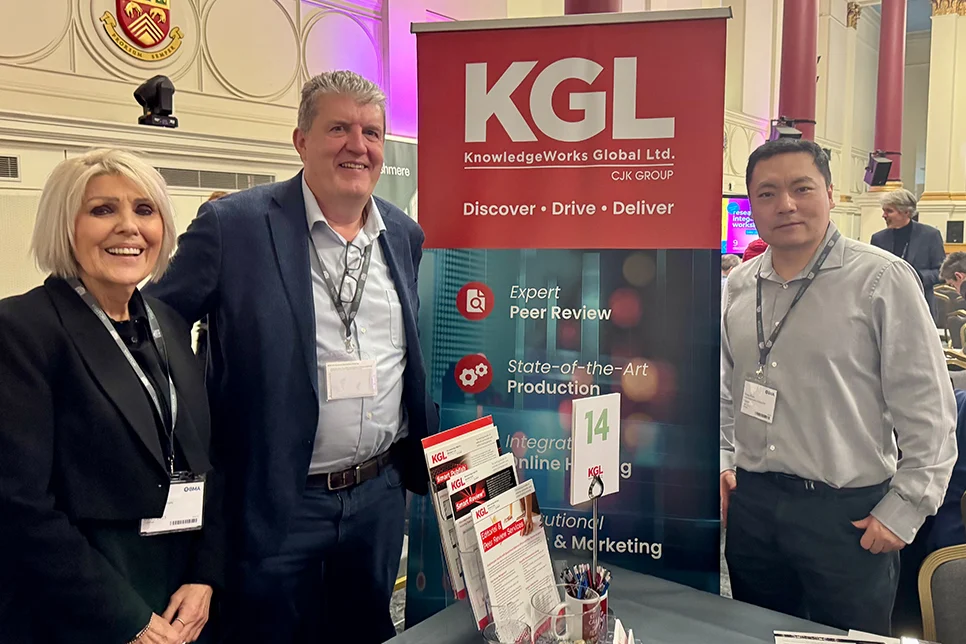
by Adrian Stanley, Chief Business Development Officer, KGL; and Hong Zhou, VP, Product Management, KGL
The 2025 STM Innovator Fair (December 9 in London) brought together leaders from across the scholarly ecosystem to examine how research integrity is evolving in an era of rapid technological change. As both attendees and practitioners deeply engaged in these issues, we left the meeting with a shared sense that the landscape is shifting faster than ever. Integrity is no longer a downstream activity. It is becoming an upstream expectation that requires coordinated people, workflows, and technology working in concert.
Publishers today face intensifying pressures: rising submissions, increasingly sophisticated AI-generated content, overlapping integrity tools, and limited internal capacity. Editors are navigating more signals, more noise, and more uncertainty. Amid this complexity, the core challenge is not technology alone, but how to structure workflows that bring clarity and defensibility to decisions.
Here are our top six takeaways from this year’s STM Innovator Fair.
-
AI Is the Co-Pilot, Not the Autopilot
Across workflows—from integrity screening to peer review and researcher support—the consensus is clear: AI analyzes; humans decide.AI is increasingly trusted to handle scale, pattern detection, and data extraction, but editorial judgment, accountability, and trust remain firmly human. Human-in-the-loop design is now the industry’s credibility baseline.
-
From “AI-Enabled” to “AI-Fit-for-Purpose”
AI is no longer optional across the research lifecycle, but generic models are insufficient. The most effective solutions are domain-specific, built with embedded expertise, guardrails, and context-aware workflows—whether for grants, manuscripts, integrity checks, or researcher well-being. Competitive advantage is shifting from “using AI” to using the right AI, in the right place, for the right job.
-
Integrity Is Moving Upstream—Before Submission
Quality and integrity control are no longer confined to peer review or post-publication checks. Innovation is pushing integrity earlier in the lifecycle, helping authors, reviewers, and funders address issues before formal submission. This upstream shift reduces downstream burden, improves signal quality, and makes correction less costly and less adversarial.
-
Trust Is Shifting from Text, images to Identity and Data
The next frontier of research integrity goes beyond text and image manipulation. Trust now depends on verifying who is behind the research and the data that supports it—including researcher identity, funding sources, data provenance, and reproducibility signals. Identity and data verification are becoming as critical as content review in maintaining confidence in the scholarly record.
-
Collaboration Is Essential—but Creates New Complexity
No single tool or organization can address research integrity alone. The strongest innovations are emerging from cross-sector, multi-tool collaboration. Publishers, startups, and platforms co-build interoperable solutions. Technology is also unlocking new resources across the ecosystem, from AI licensing models that extend content value to AI-powered translation that expands the global reviewer pool. At the same time, convergence of capabilities is creating solution overload and product homogenization, making tool selection increasingly difficult for publishers.
-
Trusted Research Remains the North Star
Despite rapid technological change, the underlying goal is unchanged: advancing trusted research. AI, automation, ecosystem partnerships, and new workflows are not ends in themselves—they matter only insofar as they strengthen credibility and Increase transparency
The STM Innovator Fair reinforced a simple conclusion. The future of integrity will not be defined by tools alone, but by how people, workflows, and technology are brought together. The organizations that succeed will be those that create clarity within complexity and uphold trust as the industry’s guiding principle.
KnowledgeWorks Global Ltd. (KGL) is the industry leader in editorial, production, online hosting, and transformative services for every stage of the content lifecycle. We are your source for society services, research integrity, intelligent automation, digital delivery, and more. Email us at info@kwglobal.com.
Related Posts

Discovery Is Becoming an AI-Native Workflow: Why the KGL–Cashmere Partnership Matters

Why Program Chairs Struggle as Meetings Become More Complex—and What Actually Helps