
Blog post
Evaluating Peer Review Systems: 5 Lessons for a Successful RFP and Platform Transition
8 Apr 2026


By Kevin Lomangino,
Director, KGL Consulting

Across scholarly publishing, leaders are taking a closer look at the manuscript submission and peer review platforms that power their publishing programs.
Helping organizations navigate these evaluations is a fast-growing area of work for our team at KGL Consulting.
Why Publishers are Reassessing Their Systems
The reasons are easy to see. Authors increasingly expect a smoother submission experience. Editors want better reporting and analytics. Publishers need stronger integration with research integrity tools, production systems, and data repositories. And a new generation of vendors is entering the market with modern interfaces and ambitious product roadmaps.
But choosing a new system and successfully migrating away from your current platform is far from straightforward.
Peer review systems sit at the heart of journal operations. Changing them affects authors, editors, reviewers, production vendors, and downstream systems. Considering change also forces publishers to navigate a difficult strategic choice: stick with established platforms that are stable but slower to evolve, or move to newer systems that promise innovation but have not been tested over decades of use.
Five Lessons from Recent RFPs
Through our work in this space, we’ve distilled five principles that are particularly important for an effective evaluation process and transition. While not a comprehensive checklist, attention to these issues will help address some common challenges and mitigate key risks of a system migration.
-
Start with workflows, not systems.
Before comparing systems, organizations need a clear understanding of their current editorial workflows, including what’s working well and the pain points. Interviews with editors, editorial staff, and other stakeholders are essential to defining requirements and avoiding expensive surprises later. Documenting and mapping the process helps clarify how your team works today, whether the new system will support it, and what may need to change during the transition.
-
Don’t rebuild the old process in the new platform.
A common pitfall in system migrations is trying to replicate every workflow, customization, and workaround from the legacy system. Stakeholders naturally focus on what they might lose or how difficult it will be to change established habits. But a platform transition is a rare opportunity to rethink how editorial operations actually work and improve them. Journal owners should resist the urge to reproduce the old environment and instead ask which processes can be simplified, standardized, or automated in the new system.
-
Carefully assess integrations.
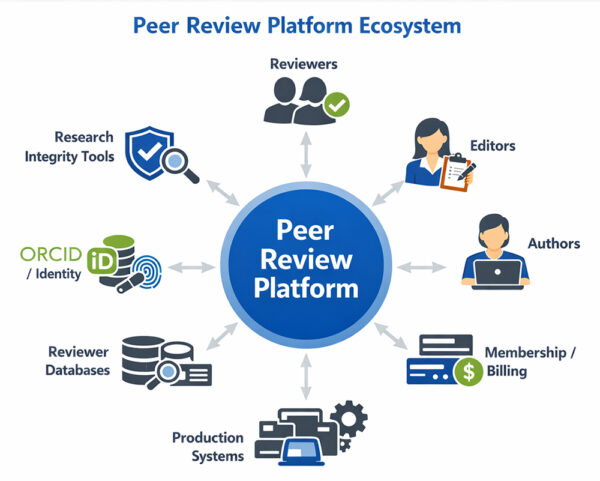
Peer review systems are the core of a complex ecosystem that may include research integrity tools, reviewer databases, author identifiers such as ORCID, and invoicing or membership systems. During an RFP process, it’s easy to focus on submission workflows and assume these connections will fall into place. In practice, integrations are often the most complicated part of a transition, and getting them right can be expensive. Publishers should identify critical integrations early and ask vendors to clearly explain how those connections will work, what level of customization may be required, and who will be responsible for building and maintaining them.
-
Balance innovation and risk.
Legacy platforms offer stability, extensive integrations, and large support teams. Emerging platforms often provide better user experiences and faster innovation cycles. The real decision is not simply which system is “better,” but which partner best aligns with the journal’s long-term strategy and risk tolerance. Clarity on these points will help your organization make a more informed decision.
-
Negotiate the exit before you sign the contract.
Pricing often receives the most attention during an RFP process. But the most important provisions may be the ones that govern how the relationship ends. Journal owners should carefully review termination rights, payment structures (e.g. upfront vs. milestone-based payments), and data ownership and return provisions. If a vendor runs into operational or financial trouble, your ability to exit the agreement and retrieve your data in usable formats will be essential. Those safeguards only exist if they are negotiated upfront.
Getting the Decision Right
A peer review platform transition has long-term operational and strategic consequences. Taking the time to structure the evaluation carefully can make the difference between a smooth transition and years of frustration.
At KGL Consulting, we approach these projects from two complementary perspectives: a deep understanding of the day-to-day realities of editorial offices, and a strategic view informed by managing hundreds of RFP processes and negotiations across the scholarly publishing ecosystem.
And we understand best practices for editorial teams. So our support isn’t limited to managing an RFP; we help organizations evaluate how their workflows, integrations, and editorial processes will function in a new platform. Our goal is not just to select a system, but to ensure the transition supports the long-term needs of editors, authors, and the broader publishing program.
If your organization is considering a review of its submission and peer review systems, we would be happy to discuss how we can help.
Learn more about KGL Consulting services or contact us at info@kwglobal.com to set up a complimentary consultation.
Related Posts

Discovery Is Becoming an AI-Native Workflow: Why the KGL–Cashmere Partnership Matters

Why Program Chairs Struggle as Meetings Become More Complex—and What Actually Helps